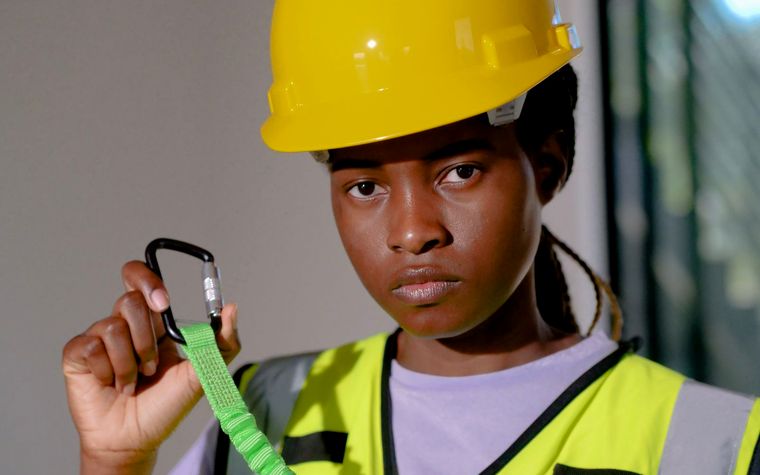
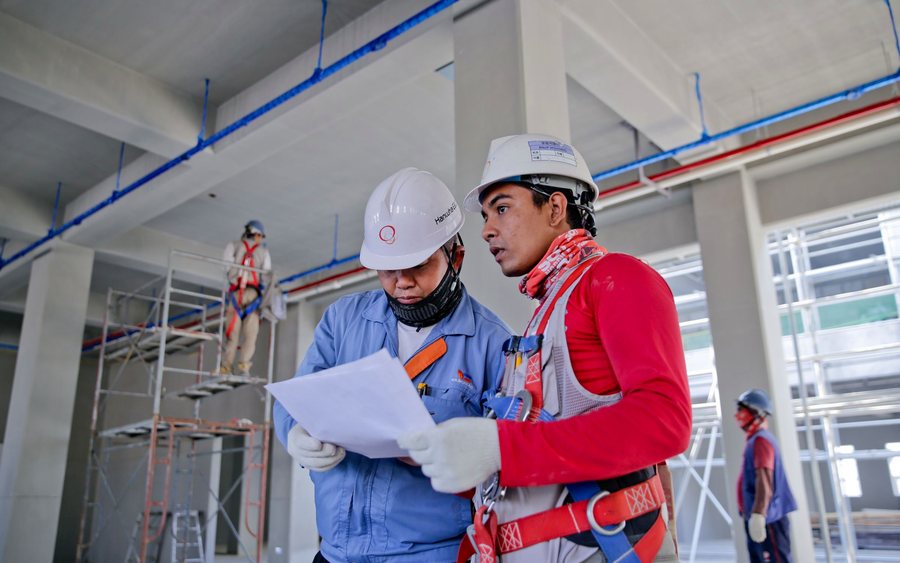
The C in the ABCD of fall protection — the connection between harness and anchor — is where most specification decisions are actually made. Two options dominate: an energy-absorbing lanyard, or a retractable type fall arrester, commonly called a self-retracting lifeline or block.
They are not interchangeable.
The core difference
An energy-absorbing lanyard is a fixed length of webbing or rope with an absorber in line. It hangs slack. In a fall the worker free-falls the slack, then the absorber tears open to limit the force.
A retractable block keeps the line under light tension at all times, paying out and retracting as the worker moves. In a fall it locks quickly, like a seatbelt, so free fall is short.
That single difference — slack versus tension — drives everything else.
Clearance
This is usually the deciding factor. Because a lanyard allows real free fall before the absorber engages, a lanyard system needs substantial clearance below the anchor: with a 2 m lanyard, commonly around 6 m once absorber deployment, worker height and a safety margin are added.
A block arrests over a much shorter distance, so it will often work where a lanyard cannot fit at all. If you are working at intermediate height — a few metres up, with a floor or obstruction below — the block is frequently the only workable choice. The fall clearance calculation is worth running before you decide.
Mobility
A block’s line follows the worker and stays out of the way, which suits climbing and work over a wider area. A lanyard is simpler but leaves slack that snags, and workers have to manage it.
Where a worker must move continuously without ever disconnecting, a twin-leg (forked) lanyard has the advantage: one leg stays attached while the other is moved to the next anchor, giving genuine 100% tie-off. Blocks generally do not offer that on their own — you would need two.
Cost, weight and maintenance
Lanyards are far cheaper, lighter, have nothing mechanical to fail, and are simple to inspect visually. Blocks cost significantly more, are heavier at the anchor, contain a mechanism, and typically require periodic servicing by the manufacturer or an authorised centre in addition to routine inspection.
For a large workforce this matters. Kitting out a hundred workers with blocks is a very different budget from a hundred lanyards, and the servicing obligation is ongoing.
Where each one is the wrong choice
Do not use a lanyard when:
- Clearance below is limited
- The anchor cannot be placed above the worker
- Continuous movement means slack will constantly snag
Do not use a block when:
- It is anchored at or below foot level and is not specifically rated for that. Most are designed for overhead anchorage.
- It would be used over a sharp or leading edge without being rated for edge use. A standard block’s line can be cut over an edge during a fall.
- It is dragged horizontally so the line rubs across structure.
A rule of thumb, and its limits
Broadly: limited clearance or lots of movement points to a block; generous clearance, overhead anchor and tight budget points to a lanyard; the need for continuous attachment while relocating points to a twin-leg lanyard.
That is a starting point, not a specification. The right answer depends on the actual anchor position, the actual clearance, the edges present, and how the work is done. Where the choice is not obvious, involve a competent person — and tell your supplier what the work looks like rather than only what product you think you want. We are often able to suggest a configuration that solves the problem more cheaply than the one originally asked for.
General guidance only. Selection of fall protection equipment must be based on a site-specific risk assessment carried out by a competent person, and on the manufacturer’s instructions for the specific products under consideration.